
26 KiB
The False Narrative: A Due Diligence Guide
TL;DR
- Multiple community members report that flagship claims regarding open-source licensing, safety, productivity, and "community" growth are highly manipulated or demonstrably false.
- The machines are often described as "toys" that are 4-5x more expensive than industrial equivalents while delivering fractionally lower performance.
- Engagement metrics are reported as fake: "150k followers" resulting in only a few dozen likes, indicating a platform that has lost all genuine attention.
- Before investing, perform a rigorous due-diligence process: verify active production, inspect actual design origins, and ignore "guilt-tripping" marketing.
Background: The Gap Between Promise and Reality
Precious Plastic burst onto the scene offering a compelling narrative: open designs, community-built machines, and local micro-recycling businesses turning waste into value. For many, it provided hope and a starting point to learn, experiment, and mobilize around plastic waste.
But over time, a growing number of practitioners allege a persistent gap between promotional claims and on-the-ground reality—especially around safety, cost, throughput, actual business viability, and platform governance.
This article organizes those concerns into recurring claim-versus-reality themes, and suggests how to independently verify each one.
The Grand Promises
1) “Sustainable Impact at Scale”
- The claim: Traditional recycling is "not working," but local micro-recycling is scaling globally with "1,000+ workspaces" to save the planet.
- What users report: Traditional recycling works—just not with "Precious Plastic toys." Critics allege the "1,000+" claims are manipulated metrics. Reports from within the trade suggest that over 1,300+ workspaces have been "censored or rejected" from the map for not being "obedient," leaving behind a cluttered map of mostly inactive "ghost" profiles. Genuine engagement is virtually non-existent, often reaching only a few dozen likes despite "150k followers."
- Why it matters: Manipulated success metrics hide a high rejection/attrition rate and mislead the public about the actual scale of the network.
2) “Make Money With These Machines”
- The claim: You can easily launch a profitable business selling high-quality products.
- What users report: "Official" designs lack the performance and quality required for market-grade products. Most active users report that items are "one-offs" at best—low-value art or gift shop trinkets—rather than durable, functional products. Running a real business is reported as "impossible" due to the modest throughput and high scrap rate of the equipment.
- Why it matters: Overly optimistic business claims cause financial harm; professional products require industrial-grade strength, not "gift-shop" aesthetics.
The Equipment & Engineering
3) “HQ Develops Field-Ready Solutions”
- The claim: A central, expert team delivers robust R&D and field-ready solutions.
- What users report: There is an emphasis on branding and storytelling over industrial-grade engineering. Reports allege that in over 6 years, the "elite" have not been seen engaging in daily support or development work. Furthermore, "helping" or supporting newcomers was reportedly explicitly prohibited, as was posting independent content like alternative tools, designs, or even supporting software. Critics describe this as a hostile "extraction logic"—where the core team captures marketing value and donations while aggressively suppressing the actual trade and the people working on it.
- Why it matters: A project that prohibits technical support and exhibits a hostile attitude toward its own practitioners is not a community—it's a parasitic marketing front that harms the very trade it claims to promote.
4) “Easy to Build & Priced for No One to be Ever Left Out”
- The claim: Designs are cheap and "no maker is ever priced out of saving the planet."
- What users report: These "frankenstein" machines often cost up to 5 times more than professional traditional machinery. Poor documentation and "dirty skimming" from others' work often forces builders to redesign components from scratch at their own expense.
- Why it matters: High equipment costs create a massive barrier to entry, paradoxical to the "open-source" and "inclusive" branding.
5) “Safe to Use”
- The claim: Designs are safe for operation in community environments.
- What users report: Builders report unshielded pinch points and inadequate thermal protection. Alarmingly, many users describe the machines as "dangerous toys" and issue urgent warnings to "keep your kids safe." Critiques aimed at improving safety are frequently met with "censorship" or "bullying" by the platform's core group rather than technical fixes.
- Why it matters: Shredders, heaters, and rotating shafts can cause permanent injury or fires. A culture that prioritizes marketing over safety ignores professional liability and human risk.
The Platform & Ecosystem
6) “100% Free & Open Source”
- The claim: Anyone can freely use, modify, and share all the designs forever.
- What users report: While some files are public, critics argue that the "open" designs are often faulty, incomplete, and effectively impossible to maintain or update in a traditional open-source manner. The ecosystem is described as being dominated by proprietary vendors who extract significant profit margins. Furthermore, while marketing materials advertise these designs as "accessible" with BOMs (Bill of Materials) as low as 100-300 Euro, users report that building a safe, functional machine requires a complete engineering redesign, often ballooning costs to 10x the advertised material price—even before accounting for professional labor.
- Why it matters: “Open source” is a specific, testable legal standard. Using it as a marketing label for unverified, faulty engineering prototypes while hiding the true financial cost (and profiteering through proprietary vendors) undermines trust and creates massive financial risks for builders.
- What to check: Check the "last updated" date on official design files—if they are years old despite known bugs, they are functionally dead. Research "True Build Cost" threads in independent forums. Compare the prices of "official" kit components against generic industrial suppliers.
7) “Major Brands using the Project”
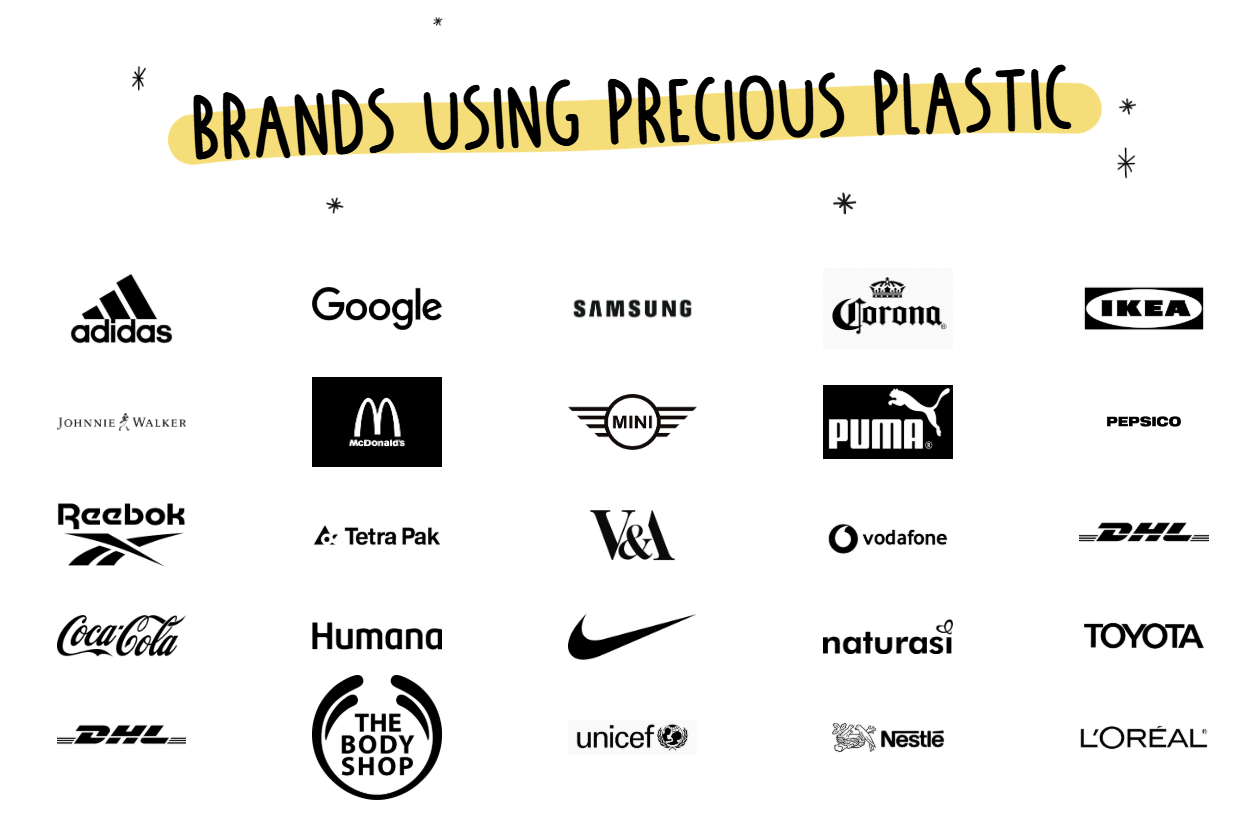
- The claim: A global ecosystem where "major brands" (like Adidas, Google, Samsung, and Nike) are actively using the project's machines and platform.
- What users report: This claim is described as a blatant fraud and a potential felony, as these brands have never been seen participating in the official Discord, nor is there a single verifiable photo or social media post showing them using the equipment. Critics note that the "Brands using Precious Plastic" graphic is a hoax used as a bait to lure newcomers and manufacture false institutional trust. Any attempt to ask for evidence or verification of these partnerships is reportedly met with harassment, censorship, and immediate banning from all official channels.
- Why it matters: Claiming usage by Fortune 500 companies without evidence is a significant legal and ethical violation ("fraud"). Using these logos to solicit donations and manage the community's perception is a hallmark of high-control deceptive marketing.
8) “The Platform & Ecosystem”
- The claim: A scalable, open platform that coordinates the global recycling community.
- What users report: The platform is reported to be built on proprietary software, with critical infrastructure and logic kept undisclosed. This makes it impossible for users to replicate or independently host the system, serving primarily as a tool for the owners to leverage control over the network. Inquiries or requests for technical openness—such as an API, interoperability, or extensions—are reportedly met with harsh insults, censorship, and immediate bans, effectively silencing any attempt at decentralization or technical excellence.
- Why it matters: A proprietary, non-replicable platform creates a "trap" where users contribute data to a system they don't own, and any technical challenge to this centralized control is met with institutional hostility.
Governance & Transparency
9) “Revenues Go Back to the Community”
- The claim: Earnings from the Bazaar and donations keep the "designs open-source and free."
- What users report: The "Bazaar" is reported to be "tweaked" by an elite set of vendors (e.g., MadPlastic, EasyMoulds) to sell "utter overpriced garbage," with reports of targeting markets in Africa with expensive, low-performance equipment. Critics allege that profits go directly to the owners—specifically Dave Hakkens, Sigolene, and Adrian—with absolutely nothing returned to the community in terms of development or support. Users report that asking for data or financial evidence results in immediate "harassment, censorship, and banning" rather than transparency.
- Why it matters: Profiteering from low-income regions and extracting volunteer-built brand value for personal gain—while suppressing technical critique—is a significant violation of "community-driven" and "sustainable" ethics.
10) “Community-Driven Governance”
- The claim: The community actively shapes the project's direction and standards.
- What users report: Control is absolute and top-down. The ecosystem is described as the "most violent, corrupt, and fraudulent" group in open-source history by some former members. Users report being "bullied" or "censored" for attempting to participate or improve designs. Talented practitioners often leave, describing the leadership as a "cult" that prioritizes "brainwashing" over collaboration.
- Why it matters: Real community governance requires inclusion, not just a "marketing backbone" of free contributors. Gatekeeping and censorship destroy the "Open" in Open Source.
11) “Totally Transparent Operations”
- The claim: Decision-making, development roadmaps, and administrative actions are completely open.
- What users report: Insiders and ex-team members allege the core leadership is "not what they are pretending." Operations are described as "perverse" and "fraudulent," with reports of news outlets and law enforcement agencies being notified. Communication within the "10k Discord" is described as mostly lurkers, with any real technical alternatives or pointed questions about money being aggressively censored.
- Why it matters: Allegations of fraud from former team members are a critical red flag that warrants immediate, independent legal and financial scrutiny.
12) “Our Designs, Our Workspaces, Our Platform” (Credit Theft & Ownership claims)
- The claim: A massive, unified network powered by the core organization, famously branded as "our designs," "our workspaces," and "our platform."
- What users report: Part of the massive indoctrination is the repeated use of "our" to co-opt independent work and infrastructure. In fact, most of the workspaces mapped or claimed literally have nothing to do with PreciousPlastic, do not use any of the official designs, and are not actively present on the platform. Furthermore, the very platform itself—often touted as a core asset—was reportedly built entirely by unpaid volunteers who have long since left. The "profiteering elite" who currently control the brand and its revenues did not contribute to its development, yet they have removed any credits or mentions of the original creators. Despite this theft of "ownership," they exhibit zero ongoing maintenance of the content or the directory. It is reported that over 1,500 pins have been rejected or censored, while the remaining directory content is largely outdated, broken, or misleading. Alarmingly, this stale content is reportedly used as a backdrop for self-advertising to solicit donations and financial support, effectively monetizing the work of the very people they have "erased." Additionally, practitioners report that there is virtually no actual relation between "PP HQ" and the workspaces they claim to represent. Those who have attempted direct contact describe being met with disrespect, dismissiveness, and "down-talks" from leadership who project an image of untouchable "Gurus." Despite this hostility, many professionals reportedly feel forced to remain associated with the PP brand solely to protect their own reputations.
- Why it matters: Claiming independent work and volunteer-built infrastructure as "ours" — while simultaneously censoring contributors and letting the actual content rot — artificially inflates the project's scale while systematically erasing the labor and innovation of the people who actually built the movement.
The Community Experience: A “Dark Place” for Talent
Beyond technical failures, a recurring theme in reports is the toxic environment on the official platform:
- The Discord Dead-End: For many, the official Discord has become a "dark place" where technical questions often go unanswered or get buried in duplicate threads. Critics report that fruitful technical discussions have been non-existent for over six years, as they are systematically undermined by the owners and proprietary vendors who control the discourse. Hundreds of participants are reportedly "cut off" or banned on a regular basis. Any question, link, or remark that challenges the project's narrative or the business model of its beneficiaries—including alternative designs, better-priced equipment, or technical issues with "official" machines—is aggressively suppressed.
- The Culture of Attrition: Talented engineers and designers often leave early, reporting that participation feels like being "wasted on a cult and scam." Common exit feedback includes phrases like "something smells odd here" and "this is perverse."
- Institutional Violence: Reports describe an environment of "violence and lies" where technical critique is suppressed to protect the "Official" brand and revenue from taxpayer/NGO funds.
Case Study: Weaponizing the Platform Against Critics
A primary example of the "Institutional Violence" mentioned above is the public smear campaign launched by the core team against long-term contributors who raise technical or financial questions.
The "OSR-Plastic.org" Blacklisting
The core team published a coordinated "Warning" article targeting a 8-year veteran of the community. This post serves as a textbook example of how the platform is used to "poison the well" against engineering-led & hands-on critique but also large sets related knowledge in the very field:
- The Narrative: The critic is labeled a "Troll," "Data Thief," and "Harasser" to justify a complete ban from all platforms.
- The Admission of Censorship: The team admits to manually tracking IPs and VPNs to ban over 50 accounts associated with this single individual—confirming the "Aggressive Censorship" reported by other builders.
- The Financial Motivation: The smear campaign was explicitly launched during a "Version 5" fundraising window, stating that the critic was "targeting large donors"—indicating that protecting the flow of donations is prioritized over resolving technical disputes or fixing designs.
- The Outcome: By labeling a professional machine builder as "illegal" and "violent," the organization effectively "jails" his 8+ years of expertise, preventing newcomers from hearing well-documented critiques (and designs).
Analysis of the Smear
This behavior demonstrates a shift from an "Open Source Community" to a "Protected Brand." In healthy engineering circles, technical claims (e.g., "machines are inefficient") are refuted with data and testing. In this ecosystem, they are instead met with character assassination, blacklisting, and "Report This User" campaigns. Alarmingly, this hostility has been specifically directed at vulnerable community members—including a 65-year-old woman and a disabled retired software engineer—who had invested years of resources and support. It becomes evident that objective field data, collected over years of customer interaction, is perceived not as constructive feedback, but as a direct threat to the organization's extractive business model. Furthermore, this culture of targeted harassment has drawn public support from analogous organizations like Open Source Ecology, reflecting a troubling, broader trend in certain hardware projects where noble volunteer goals are used as a shield to justify censorship, discriminatory behavior, and the humiliation of dedicated contributors.
Systemic Issues Reported by Builders
- Documentation Rot: Guides heavily diverge from current designs; repositories lack revision history.
- BOM Drift: Hardware part numbers become obsolete; local substitutions lead to severe function problems.
- Tolerances and QA: Crucial variables like blade alignment, temperature gradients, and feed moisture control are under-specified.
- Safety by Omission: Guards, interlocks, and thermal protections are left as an "exercise for the builder."
- Vendor Dependence: “DIY” machines frequently rely on hard-to-source parts sold only by official vendors at inflated "prestige" prices.
- Engineering Gap: No evidence of qualified industrial engineers or transparent testing reports for flagship designs.
Due Diligence Checklist (Before You Spend Real Money)
- Licensing and IP: Verify exact licenses and commercial usage rights.
- Technical Documentation: Demand full CAD, toleranced drawings, and verified wiring schematics.
- Safety and Compliance: Formally map risks (ISO 12100). Implement E-stops, guarding, and get third-party sign-off.
- Performance and Economics: Request measured data covering duty cycle and tensile strength. Build a realistic ROI taking downtime into account.
- Operations and Supply Chain: Secure a localized, clean source of feedstock before building machines.
- Governance and Transparency: Investigate the source's update history and community dispute resolution logs.
Constructive Recommendations for the Project
- Clarify licensing across all repos; pursue OSHWA certification where feasible.
- Publish third-party safety reviews and bake safety (guards, interlocks, standardized electrical controls) directly into all official designs.
- Maintain version-controlled, peer-reviewed documentation with standard release engineering.
- Provide empirically measured performance data, including test methods.
- Release annual transparency reports detailing finances, governance actions, and roadmap outcomes.
If You’re a Builder Today
- Treat these machine designs strictly as initial prototypes. Budget for redesigns and safety systems.
- Validate all platform claims with your own tests and independent communities.
- Start extremely small: isolate a single product idea with a highly reliable feedstock source.
- Log all data: experiments, failures, fixes, and true costs.
Summary of Implications
Participation in a compromised and heavily manipulated ecosystem carries downstream risks that extend far beyond a wasted financial investment, as we've seen in the hundred times:
- Legal Liability: Operating uncertified, under-engineered shredders and thermal machines in public or educational spaces exposes builders to severe civil and criminal liability if an accident occurs. Furthermore, adopting the project's tactic of claiming unverified "partnerships" with major brands can lead to trademark infringement and fraud charges.
- Career Damage: Professional engineers, educators, and makers risk severe reputational harm by attaching their names and work to a platform recognized in critical industry circles for suppressing technical truth, deploying deceptive metrics, and employing hostile community management.
- Health Risks: The physical dangers are real and immediate. Relying on "guided" DIY thermal controls and unshielded mechanical designs carries the risk of permanent physical injury, workshop fires, and long-term respiratory harm from improperly managed plastic fumes.
- Credit & Intellectual Property Theft: Systematically claiming credit for independent workspaces, community innovations, and volunteer-developed infrastructure artificially inflates the project's scale while erasing the actual creators. Participating in this ecosystem means your intellectual rigor and unpaid labor are highly likely to be co-opted, rebranded, and monetized by the central organization without attribution.
- Maker & Enthusiast Exploitation: Publishing downplayed engineering risks and faked, artificially low Bill of Materials (BOMs) sets well-meaning hobbyists up for failure. By concealing the true cost and complexity of building these machines, the project systematically drains the limited time and personal budgets of makers, ultimately discouraging their participation in genuine hardware communities once the deceptive promises break down.
- Psychological Damage: Immersion in high-control environments that rely on guilt-tripping ("saving the planet"), aggressive censorship, and gaslighting leads to severe volunteer burnout. Participants often suffer emotional distress upon realizing their genuine goodwill has been weaponized for someone else's extractive profit.
- Societal Harm: When centralized platforms harvest community funding and attention without delivering functional results, public trust in grassroots ecological initiatives is eroded. This deceptive marketing breeds cynicism, directly reducing public and institutional support for legitimate environmental efforts.
- Open-Source Integrity: Labeling a proprietary, heavily censored, and centralized ecosystem as an "Open Source" project damages the credibility of the broader open hardware movement. Using the halo of open-source ethics purely as a marketing funnel undermines the foundational tenets of transparent peer review, decentralized collaboration, and shared ownership.
- Subject-Related Impact: Extractive platforms ultimately harm the ecological cause they use for marketing. By monopolizing search algorithms, rankings, diverting grant funding, and burning out enthusiastic volunteers on inefficient "toys," the legitimate progress of sustainable, safe, and scalable micro-recycling is actively hindered.
References and Further Reading
- Community thread compiling critiques and experiences: https://forum.polymech.info/t/preciousplastic-review/11066
- Safety standards to consult: ISO 12100 (risk assessment), ISO 13857 (safety distances/guards), IEC 60204-1 (electrical equipment), UL 508A (industrial control panels).
- Always seek local regulations for educational or public settings, as requirements differ in strictness by region.
- Against Discord Channels - Comprehensive Analysis
- Modern Cults Analysis - A Framework for Deception
- Heatlth impacts 'Plastic Recycling'
Appendix: The Life Cycle of Platform Decay (Wiki:Enshittification)
The evolution of centralized digital ecosystems often follows a redundant trajectory of systemic degradation, a process formally described as enshittification. This phenomenon marks the transition from value-creation at the service level to extractive logic at the institutional level, where utility is systematically sacrificed for monopoly rent.
According to the analytical framework established by writer Cory Doctorow, platforms typically progress through three predictable phases of decay:
- The User Acquisition Phase: During initial growth, platforms maximize surplus value for users to build network effects and establish an operational "moat" around the ecosystem.
- The Monetization Phase: Once a captive audience is secured, the platform shifts its surplus value toward business customers (e.g., advertisers, premium vendors, or sponsors). This stage optimizes for revenue generation, often at the direct expense of the user experience.
- The Final Extraction Phase: In the terminal stage, the platform owner attempts to reclaim all surplus for themselves, squeezing both the end-users and the business partners. The system eventually becomes a "hollow shell" dedicated solely to rent-seeking and advertising, with minimal functional utility remaining.
This cycle reflects the historical economic concept of monopoly rent. Once an entity controls the digital "space" where interaction and trade occur, it no longer needs to compete on quality or service; it only needs to maintain control over the environment. Participants become "digital sharecroppers," cultivating value for a landlord who has transitioned from a provider to a harvester.
For any participant in a high-control ecosystem, the ultimate due diligence question is whether the perceived convenience of staying is outweighed by the systemic cost of being harvested as the product.
Final Note
This report aims to bridge the gap between marketing "brainwashing" and the on-the-ground reality of community recycling. The goal is to channel frustration into practical due diligence and to protect new builders from the financial and safety risks associated with unverified "frankenstein" designs.
If you have data, corrections, or robust counterexamples—or if you have been "censored" elsewhere and want to share your experience—please reach out through neutral, transparent channels.